


Art, Film, Music...
| Visual Elements of Design | |
|---|---|
| Overview lecture on the importance of the visual elements of design in art. | |
Best Art Schools - An Overview
Author: Ian Koch
Do you know art school is a colloquial term? The educational institution that concentrates on the visual arts, especially graphic design, sculpture, painting, and illustration is termed as best art schools. There has always been a great interest for art schools and arts in general - especially from young people. The art profession is unique and exclusive and are recruiting well - and especially the most famous schools are very attractive for young people with artistic talents.
The art schools offer most of the programs in culinary, fashion, media arts and design. You can easily earn your Bachelor of art degree as well as your Master of art degree at the most of the art institutes either on-campus or off-campus through online. You can visit the site of these best art institutes in the online to request a catalog. Even the degree in forensic sciences are also offered by some of the best colleges in forensic sciences that includes Chaminade University in Honolulu, cedar crest college, Youngstown state university, and Loyola University New Orleans.
On-campus art schools The on-campus programs are focused mainly to teach you both the technique and its practical application. The masonry institutions offer you to take your degree and pertain it in whatever way you wish in the real world, whether you want to be a design animator or a police sketch artist.
University of Phoenix, Rockport college, DePaul University, Strayer University, Grand Canyon University and Florida Metropolitan Universities are being considered as the top most arts colleges. You can choose from over 80 diploma and degree programs - everything from culinary management to Professional bridal consultant.
Off-campus art institutes As "bricks and mortar" schools and "efficient" universities are constantly expanding their online courses, this is a high time to know about the availability of online school of arts. The commonly available arts degree programs are BA (Hons) in Artist blacksmithing, contemporary applied arts, Illustration, Photography, Graphic and media designing etc. The art institute online, University of Liverpool, West wood college, and Virginia College are the pioneer colleges offering multitude of opportunities for the students to learn and to grow by online.
When you graduate, you'll be prepared to apply the managerial talents and skills you've obtained through this program by starting your own business, working in research institutions, or as at least quality control officer.
Some of the institutions offer extensive job placement assistance to their students by arranging campus interview also!
About the Author:
Ian Koch is a writer and internet publisher who likes to publish College Education Info Resources and related stuff. Check out the-best-colleges.com for more.
Article Source: ArticlesBase.com - Best Art Schools- An Overview
| |
Applied Arts And Design: Turning Creativity Into A Career
It's the intersection of high-tech and creativity; a bubbling potion of strategy, purpose, and communication. A career in Applied Arts and Design is both dynamic and versatile. Choose the clients and projects that inspire you to create masterpieces time and time again.
The Career 411
Professionals in applied arts and design are really graphic designers at heart and practice. They use a variety of manual and digital tools to create dynamic messaging for a variety of purposes. According to the Association of Independent Colleges of Art and Design, "Artists and designers are central to our culture and our commerce; indeed, our society would not be where it is today without them."
Some designers are commercially-oriented; they create advertisements, direct mail, and websites that sell products and services. Others work for non-profit organizations, using their talents to convey information and promote worthy causes. And still others are fine artists--designing multimedia presentations that speak from the heart and reveal the beauty in a society, a historic event, or an inspirational thought.
Why This Career Has an Edge
Graphic designers relish several aspects of their careers. The ability to use technology creatively is key. A collection of software suites allows designers to manipulate photographs, experiment with fonts, and add a musical component to their work. Using interactive tools to bring a static design to life on the Web is an increasingly popular process that well-trained designers can master.
Job opportunity is another big plus. The Bureau of Labor Statistics (BLS) reports that employment of graphic designers projected to increase by 10 percent; that's about as fast as average for all occupations through 2016. Advertisers, publishers, and computer design firms consistently court qualified candidates.
Career in the Numbers
Graphic designers held about 261,000 jobs in 2006, with most working in specialized design services. In the coming decade, another 26,000 jobs are projected to be added in the industry. According to the BLS, top employers include:
• Advertisers, publishers, and computer design firms
• Various segments of the Internet as well as movie, television, and video entertainment markets
• Video gaming, web design, cell phones and PDAs and other interactive media
PayScale reports that the average starting salary for graphic designers is $31,531. Those with 20 or more years of experience in the industry typically earn $45,744. Potential salary levels are influenced by specialty, geography, and experience.
How to Get There
No matter what particular area of applied arts and design you choose, the steps that lead there should contain some common elements. The American Institute of Graphic Arts suggests these courses:
• Art - Helps you work on building hand eye coordination and craftsmanship skills.
• Art and Graphic Design History - An essential part of building any designer's foundation.
• Design Theory - The elements of design, such as line, shape, space, texture, value, and color. Also, how these components work together to present a complete image.
• Typography - Combining text and imagery to communicate in a clear and compelling way.
• Grid Systems - Enables you to tackle visual problems and solve them in terms of conception, organization, and design with greater speed and confidence.
• Photography - Includes learning which angles work, different types of lighting, and different lens options.
• Design Strategy - The ability to come up with ideas and concepts that are appropriate to the design problem is critical.
By: Kelli Smith
Article Directory: http://www.articledashboard.com
Kelli Smith is the senior editor for www.Edu411.org. Edu411.org lists colleges and career institutes that offer training and programs in Applied Arts and Design Careers. Schools listed offer free information packages or academic consultation.
| |
Top 10 Art Schools - Learn How to Paint
by Pedro Sousa
The Top 10 Art Schools all focus on the same general subjects: Sculpture, Photography, Painting, Illustration and other kinds of Visual Arts. There are also other types of schools, but those are really specific to a determined subject. This list does not intend to name the top schools by order, but this can give you a real orientation for the kind of Art School that you are interested. So let's name them:
- The New York Academy of Art (Graduate School of Figurative Art) To the date, it's the only accredited school of it's kind in the world. Primary studies focus on the human figure. This is carried out with studies in drawing, painting, sculpture, art history and studying anatomy. Located in NY, USA.
- Cranbrook Academy of Art. It's a graduate school of Design, Art and Architecture. In Bloomfield Hills, MI, USA, founded in 1932, it is part of the larger Cranbrook Educational Community.
- The New School of Classical Art (NSCA) utilizes the Atelier Method of art instruction. Located in Pawtucket, Rhode Island, USA, it was founded in 2005 by the Classical Realism artist Dana Levin.
- The Art Institute of Phoenix gives its students the opportunity to live a creative career. It focuses on Web design, Interior design, Graphic design and Advertising design. Located at Phoenix, AZ, USA.
- The Iceland Academy of the Arts (Listaháskóli Íslands). It offers a university level education in the Arts. It's located in Iceland.
- The Royal Swedish Academy of Arts or Kungl (Akademien för de Fria Konsterna) is one of the Royal Academies in Sweden. Applies to a variety of visual arts including building, sculpting, painting and the other Visual Arts. It is located in Sweden, Europe.
- The Royal Academy of Arts offers a college level art education. It's an alternative to the Society of Artists. It is located in Piccadilly, London, UK.
- The California Institute of Earth Art and Architecture works with Ceramic and Earth Art technologies and is located at CA, USA.
- The China Academy of Art graduates you on Ph.D., Master's and Bachelor's degree. These are offered in Film, Multimedia, Architecture, Design and Fine-arts. Location: China.
- The Sterling and Francine Clark Art Institute offers self paced academic and research programs related to objects and issues surrounding an adaptable style of art. Located at MA, USA.
This article is a brief presentation of the Top 10 Art Schools. For more information you should consult the respective School or website. You can always seek online to get an art education.
| |
Three great courses to get you into digital film production
by artavia.seo
If you're interested in full-time filmmaking, you should know that there are several courses that you can take. One of these is the Higher National Diploma in Digital Film-Making. It's a one-year course and you have to meet specific requirements, including being at least eighteen years of age. Having a strong interest in the making of digital films is important for this kind of course, because it is not designed for someone who just wants to do something like this as a hobby. People who enrol in this course will need to write, produce and direct several products, including a music video, a documentary, two short films, and a moving image product that you choose. You'll also be required to write narratives on filmmaking, the UK industry, the Hollywood industry, and related subjects. The work will be screened publicly, as well. Upon completing it, however, you'll be ready for work in the television and film industry. You can continue for a degree, but it generally won't be necessary, since the course is designed to get you ready for employment.
An Art (Film and Video) course can also be a great choice for people who want to learn about the skills that will be needed. Developing filmmaking skills from sketchbook drawings and information is what this particular course is designed for, and it's not set up to prepare someone to move straight into a career in digital film and television, although it can help to move you toward that goal. Most people who complete this course go on for further study, but some of them have been successful for using it as employment.
If you want a filmmaking access course, Northampton has many that you can take and that can put you on the right path. Getting a Higher National Diploma in Interactive Digital Media is another way that you can head for a career in film and television. You must be eighteen to enrol, and the course is designed to give you cutting edge information and experience where digital media is concerned. It also helps you to get prepared for employment as soon as you finish the program, so you don't have to go on for more education - although you certainly can if you desire to. This course is two years long, however, and people who enrol in it should be aware of the fact that they must commit their time to it and take it seriously if they are to be successful.
There are many other courses available in Northampton and the colleges in Northampton provide a great start to a career.
About the Author
This article was written on behalf of Northampton College who are an education establishment based in Northampton and are one of the few Colleges in Northampton.
| |
Art Education: Basic Techniques of Classical Realism Oil Paintings
Author: Krista QQ(www.123giftfactory.com)
What is oil painting? Oil paints on the canvas. It's an indisputable definition. I thought that oil painting is more than that.
Any kind of figurative art (including oil painting) is thought of beforehand. The basic rules of studying drawing and painting are very closely connected with the laws of the discipline.
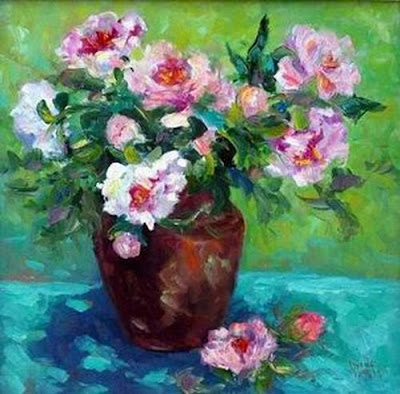
Tip 1. Brushes
You should have many brushes so that not to lose time washing them while working. Take a new brush for every new mix. Use round kolinsky brushes, No.1 to No. 10. To cover larger surfaces, you will need a few #20 to #35 brushes. For final strokes PRIPLAVLENIYE (final blending) you will need a few very soft round and flat average size squirrel brushes. Brushes should be treated very carefully. After every session they should be washed in turpentine and after that in warm water with soap.
Tip 2. Canvas
The canvas should be primed additionally a few more times and in conclusion it should be ground with fine sandpaper. After that the canvas should be scraped with a razor to remove the canvas texture till smooth dead surface similar to the egg's surface is achieved.
Tip 3. Palette
The palette must be made of hard dark wood, best of all, of pear wood. After work wash the palette with turpentine and scrape it with a razor. Before work wipe the palette with linseed oil.
Tip 4. Paper
The drawing is made on paper life-size to the smallest details. Then it is transferred to the canvas by carbon-paper. After that the drawing is outlined with brown ink because the first oil layer - IMPRIMATURA (transparent coat that is equal to the middle tone of largest, lightest object in painting) - will wash away the pencil, but the ink will remain visible almost through the last layers.
Tip 5. Still Life Objects
It is very important to have objects for still life in the studio. Don't be stingy at garage sales and flea markets, you may regret it later.
Tip 6. Lacquer
The lacquer for IMPRIMATURA is made of 2% of dry DAMAR CRYSTALS and 98% of turpentine. The lacquer for painting is made of 5-10% of dry resin and 90-95 % of turpentine. A couple of lavender oil drops are added directly to the oil-can. Scientists say lavender oil stimulates the brain. However, I think that old masters added it to eliminate the heavy turpentine smell. The lacquer for the final step consists of 30% of DAMAR CRYSTALS, 3% of linseed oil, and 67% of turpentine.
Tip 7. Canvas Cleaning
Before each new layer the canvas (ideally dried during 7 weeks) is carefully wiped with a half of an onion (in order to prepare the dried surface to absorb better) and then with linseed oil. After that the canvas is wiped with a soft piece of cloth.
Tip 8. Mixture
IMPRIMATURA, or the first paint layer. The canvas is covered with a liquid mixture based on Red Ochre, Yellow Ochre Light and Ivory Black (the mixture should have an olive hue).
Tip 9. Basic Set of Paints
The basic set of paints is the following: "Rembrandt" oil colors: Flake White, Yellow Ochre Light, Red Ochre, Burnt Umber, Raw Umber Ivory and Lamp Black (7 Basic Colors), and 4 extra colors (when necessary) which I use in the last layers: Flake Yellow (instead of it also can be used Cadmium Yellow Deep), Madder Lake Deep, Chinese Vermilion, Prussian Blue. But be careful to use these last 4 colors very sparingly.
Tip 10. TEL'NII PODMALYOVOK
The first and the second TEL'NII (flesh tones: main life colors) PODMALYOVOK (5th and 6th layers). The first TEL'NII PODMALYOVOK is made half a tone lighter and two tones lighter in colors; and half a tone darker and two tones lighter in shadows. The same is true of the second TEL'NII PODMALYOVOK.
Tip 11. PODMALYOVOK
The dead layer - the fourth PODMALYOVOK - is made with white lead, light ocher, red ocher, and burnt bone. The aim of this PODMALYOVOK is penumbra. The picture must look as if its objects were lit with moonlight - olive cold gray color. Colors are applied thickly, half a tone higher, shadows are very transparent, half a tone lower.
Tip 12. LESSIROVKA
The seventh layer --- LESSIROVKA : Details of textures, thickly applied highlights, bright reflections, and signature. In this layer you may use additional paints: Prussian blue, red cinnabar, yellow flake (cadmium yellow deep), madder lake deep.
Tip 13. Shadow PODMALYOVOK
The shadow PODMALYOVOK (the process of creating intermediate layers) is made with Burnt Umber in two layers (2nd and 3rd layers). In the second layer all details are made excluding the texture. In the third layer LESSIROVKA of the main tone masses is made with a big brush.
Tip 14. Music
Many painters get an energy charge from music. Stop listening to any modern music and begin listening only to classical music. Try to begin loving it. Last, stop looking at modern art and stop loving it. Modern bright colors and hue contrasts destroy the subtle vision of the painter who took risks to study classical painting in our time.
From the 16th century to the beginning of the 20th century artists used the seven layer technique. Like music where there are seven notes, seven keys, and within each there are seven more. 7 days in a week. 7 Layers of Paint. Each layer in oil painting must dry for seven weeks. The energy which we receive from old paintings in museums, like ghosts in old castles with old paintings, is related to this magic figure.
About the Author: * I'm a Chinese girl, I love all beautiful, fashion and artistic things, and I'd like to introduce and display an excellent selection of China fine art, gifts, traditional Chinese handicrafts, jewelry, toys, home decorations and fashion accessories to you, also give you great suggestions about gift ideas and introduce you the latest fashion trends in China.
Article Source: ArticlesBase.com - Art Education: Basic Techniques of Classical Realism Oil Paintings
| |
Theoretical Approaches to Learning Art
By: Maritza M. Conde
Theoretical Approaches to Learning Art
“Every child is an artist. The problem is how to remain an artist once he grows up.”
Picasso
As educational leaders, it is our task to enhance learning with the theories that we learn throughout our educational experiences so our children as Picasso so nicely put it could keep their imagination and continue being artists for the rest of their lives. Art is "the use of skill and imagination in the creation of aesthetic objects, environments, or experiences that can be shared with others" according to Britannica Online. In the broadest sense art is the one subject that has stayed closest to the older Latin meaning, which roughly translates to "skill" or "craft," and from an Indo-European root meaning "arrangement" or "to arrange." The purpose of this article is to explore the applications of eight to ten theories and use them to teach art education, while explaining how the information contained within the matrix created, could be transferred, and implemented to the art education program, while evaluating the pros and cons of each theory to the arts.
Theories
In the 21st century the educational system of the United States of America is in a process of change, in which it is merging and integrating new curriculums, theories, and programs into the system. All of the programs that have been created are focused on minority students, women, and students who have shown in one way or another that are at risk of not having the requirements to succeed in this educational system. Yet the techniques required for teacher to interact with the students has also been changing from writing to typing, books to computers; chalk boards to white boards; lecturing to team work.
Philosopher-educator John Dewey suggested that Americans face a choice between education as a function of society and society as a function of education. . . .Democracy demands the latter and requires citizens to develop the capacity to interpret, understand, and analyze knowledge, as well as to effectively communicate information, ideas, and concepts. (Romanowski, 2006, 9A)
Yet, theories are not permanent. They change due to our needs, culture, and beliefs for workable or accurate explanations of what the truth and purpose of education (p. 4). This may be because a theory according to DeMarrais and LeCompte (1999) is the “way we organize and explain the world we live in” (p. 3). Throughout history, our social and cultural beliefs have been influencing the educational system with a range of social theories that include but are not limited to Functionalism, Marxism, Interpretivism, and Post-modernism, which have also influenced art. Geertz (1998) states that “these approaches place great importance on presentation of the “multiple voices” of all participants – especially less powerful participants such as women, members of minority groups, and students” (DeMarrais and LeCompte, 1999 p. 38). In other words, art education, science education, mathematics, and knowledge in general are important for all individual, no matter the sex, age, ethnicity, or social status. The learning theories used today in schools are not limited to social learning theory, behaviorism, cognitive dissonance, contiguity theory, cooperative learning, Gardner, Piaget, Situated learning, Skinner, Vygotsky, Weiner, and Constructivism among others.
Interpretive theory
The interpretive theory states that school planning requires a systematic plan that has predetermined objectives or standards like the NCLB Act of 2001, since written rules and procedures, hierarchy of authority, impartial treatment of students, hiring, have characterized it and advancement based upon official credentials of teachers. The function of our schools is to give the students the tools they need so in the future they would be able to make money, have technology and have the power to teach others what they would need for the future making them available for each student, teacher, and staff. This learner believes that the USA educational system is attempting to put together an ideal educational system with Bush’s implementation of the No Child Left behind Act of 2001.
Under this law, every child in every racial, economical, and demographic group in every public school of the nation must improve their test scores in math and science standardized tests. According to King-Sears (2005), the phrase “highly qualified teacher” used to “mean those who were fully certified and extraordinarily effective in teaching students” (p. 187) but today according to the NCLB guidelines a “highly qualified teacher will have a bachelor’s degree, be fully certified, and prove they know the content they teach” (p. 187) by taking content specialized examinations. Teachers must be able to help children connect their learning to their own experiences and provide opportunities for students to manipulate and use resources to maximize academic growth. Art education is a tool used by teachers in every content area to help students connect the content learned to their own personal experiences.
Change Theories
According to Shapiro (2005), a theory of change refers to “the causal processes through which change comes about as a result of a program’s strategies and action.” These theories explore the reasoning that leads program leaders to their inferences about how changes happen. Most of there theories of change requires ‘backward mapping’ or identify the outcomes of a program. According to Shapiro (2005), the theories of change are both explicit and implicit and most include:
- Frame the specific problems to be addressed
- Frame their intervention goal
- Identify processes through which change happens
- Describe their strategies, principals and specific methods for intervention
- Delineate short-and long-term intended effects
Trait theory
The trait theory states that individuals are born with a series of inherited characteristics that gives a person the sufficient combination of traits that are suited for life, these traits can also be measured through the individual’s ability to perform a series of tasks or skills that will allow them to be efficient. This theory originated in the nineteenth century, when Gregory Mendel discovered that genes and inheritance played an important role in the characteristics and trait that an organism possessed. As the years passed, researchers focused into trying to discover the traits wanted for a particular task. In our case, many researchers focused on identifying the traits or skills needed to be successful in art.
In 1950, Myers & Briggs, a mother-daughter team, created a survey test that could identify sixteen traits that are thought to be inherited by simply answering a series of questions found at http://cbae.nmsu.edu/~dboje/teaching/490_ps1/step_1.htm . In 1974, Stogdill wrote a handbook in which he is able to identify a series of traits and skills that make a good artist such as creativity, diplomacy (that person can be tactful with others), clever, persuasive, observant, conceptually skilled, knowledgeable, organized, and a fluent speaker. Lots of other traits have been added to this theory depending on the model and organization that is implementing it. While other researchers like Machiaveli, McGregor, McClelland, Katz, Yukl, Flanagan, Bennis, and Boje continue to study and create more models based on inherited traits. While the new scientific discoveries on genes, characteristics, psychology, and chromosome dominance create more questions on the existing trait theories. Some of the questions this learner has are: 1) Does an artistic traits dominant or recessive. 2) Will scientists be able to identify a creativity gene? 3) Can a person with heterozygous genes be able to acquire and develop the traits or skills they would posses if their genes where homozygous? 4) Can we identify artists with a simple test?
Multiple Intelligence Theory
Dr. Howard Gardner developed the theory of multiple intelligence in 1983, which suggests that the traditional notion of intelligence, based on the individuals I.Q. testing is limited, so he proposed eight different intelligences based on a broader range of human potential in children and adults. Dr. Gardner (1993) says that we esteem highly articulate or logical people of our culture and that we should place equal attention on individuals who show gifts in the other intelligences such as artists, architects, musicians, naturalists, designers, dancers, therapists, entrepreneurs, and other individuals that enrich our society. Our society unfortunately does not reinforce children that posses these gift and labels them as “learning disabled”, “ADD (attention deficit disorder”, or calls them underachievers. Dr. Gardner (2000) suggests that teachers should “be trained to present their lessons in a wide variety of ways using music, cooperative learning, art activities, role play, multimedia, field trips, inner reflection, and much more” According to Armstrong (1994),
The good news is that the theory of multiple intelligences has grabbed the attention of many educators around the country, and hundreds of schools are currently using its philosophy to redesign the way it educates children. The bad new is that there are thousands of schools still out there that teach in the same old dull way, through dry lectures, and boring worksheets and textbooks. The challenge is to get this information out to many more teachers, school administrators, and others who work with children, so that each child has the opportunity to learn in ways harmonious with their unique minds.
Cognitive Developmental Theory
Based on his life long research, Piaget felt that “students should not be seen as empty vessels to be filled by expert teachers, but rather active participants in the building of their own knowledge” (Nagarjuna, 2006). According to Murray (2007), Piaget concluded “that schools should emphasize cooperative decision-making and problem solving, nurturing moral development by requiring students to work out common rules based on fairness” (p. 2). Even though the explanations offered may be incorrect today, according to the latest adult sensibilities and research, but “the fact that children do offer explanations for these things shows that they are actively working to understand the world around them” (Nagarjuna, 2006).
Jean Piaget viewed intelligence as a process that help an organism adapt to its environment and proposed four major periods of cognitive development. The four development stages described in Piaget's theory are (1) sensorimotor stage, (2) Preoperational stage, (3) Concrete operational stage, and (4) formal operational stage. Each cognitive structure in Piaget’s theory is defined by a series of traits, and corresponds loosely to specific age. These chronological periods are not rigid rules, just approximate values to set the stages in an order starting from birth to 2 years of age defining the sensorimotor stage, where the children experience the world through movement and senses and learn object permanence. The preoperational stage starts from the age of 2 to 7 years and the child has an acquisition of motor skills. In the concrete operational stage starts from 7 to 11 years and the children begin to think logically about concrete events that are taking place in their environment. In the formal operational stage begins after the age of 11 and it is when the child develops of abstract reasoning of the world around them.
Vygotsky Cognitive Theory
Vygotsky's theory is an attempt to explain consciousness as the end product of socialization in which he insists that children’s minds are shaped by the particular social and historical context in which they live and by their interactions with adults, explaining why educators will never be replaced with technology no matter the advances that we reach. His social development theories play a fundamental role in the development of cognition. Vygotsky (1978) states:
Every function in the child’s cultural development appears twice: first, on the social level, and later, on the individual level; first, between people (interpsychological) and then inside the child (intrapsychological). This applies equally to voluntary attention, to logical memory, and to the formation of concepts. All the higher functions originate as actual relationships between individuals (p.57).
Vygostsky’s theory of art developed a “dynamic overall approach by (1) the writer’s intentions, era, and background; (2) the form, content, and symbolism of the literary piece; and (3) the readers’ experience and interpretation of the work” (Lindqvist, 2003). Vygostsky did not regards art as something spiritual and metaphysical, which raises the artists genius above the shape and contents of the work being created. Instead, he saw art as a reflection how society touches the people’s lives and how society developed. Art is an excellent tool for studying not only society, but emotions, and psychology. According to Lindqvist (2003), “Vygostsky regarded the psychology of art as a theory of the social techniques of emotions. His analysis reflects the artistic process.”
Taoism
The Tao is a universal principle that covers everything from the creation of the galaxies to the way human interact with themselves and the world, showing the path needed to be followed. The Tao consists of 81 verses that are vast and go beyond all human logic. This collection of 81 short verses has survived over twenty-five centuries and their content still teaches us a great deal. The author of the Tao was Lao Tzu, a royal librarian which was asked by the emperor to write all his knowledge before leaving the kingdom to wonder China (Windridge, 1999, p. 60). According to Manson, Taoism should not be described as a religion or a philosophy since the first step to interpreting the Tao is not to be guided by the labels. The Tao is the principal of all knowledge that is external and internal; eternal and mundane and it appears eternally. The Tao is an infinite and final cycle that starts and ends in the same time. To comprehend, the Tao, in plenitude you would need 200 lives of 100 years each and you would only be able to reach the beginning of a small end, which would be the spiral that reaches all the finalities of the mind, the spirit, psychology and evolves into human thought. This can be seen in Wu’s translation of the Lao Tzu: Tao teh ching verse 7:
Heaven lasts long, and Earth abides. What is the secret of their durability? It is not because they do not live for themselves. That they can live so long? Therefore, the Sage wants to remain behind, but finds himself at the head of others; Reckons himself out,
But finds himself safe and secure. Is it not because he is selfless That his Self is realized? (p.15)
At the site http://www.thetao.info/tao/taoleader.htm shows how diverse verses of the Tao have been implemented to leadership, life, and education for example verse 17, “The highest type of ruler is one of whose existence the people are barely aware. Next comes one whom they love and praise. Next comes one whom they fear. Next comes one whom they despise and defy” (Wu, 2005, p. 35). Yet a book written so long ago provides us insight on how to be leaders in the changing world of the 21st century.
According to Astin & Astin (2000), the Tao has no beginning or end, yet it evolves with the times, which determines its expressions due to an era, a social group, or a particular task. Learning in Taoism is always orientated to a higher calling a vision, a goal, a task, a proposed problem that is awaiting a solution that will guide civilization, a group or a company to reach peace, unity and a common goal among all its members perfect enough to be used in a classroom, art classes, and for life.
Elaboration Theory
The Elaboration theory is an extension of the work previously conducted by Ausubel on advance organizers and Bruner on spiral curriculum. According Reigeluth (1992), the elaboration theory specifies that classroom instruction needs to be organized in increasing order of complexity for optimal learning. Instruction needs to be from simple lesson is presented and then it keeps getting harder until all the tasks are taught and the goals are meet. Reigeluth (1992) suggests that the lesson start with a summary of the previous class and end the class with a synthesis of that day lesson. The Elaboration theory proposes seven major strategy components: (1) an elaborative sequence, (2) learning prerequisite sequences, (3) summary, (4) synthesis, (5) analogies, (6) cognitive strategies, and (7) learner control. Elaboration theory applies to the design of instruction for the cognitive domain.
Application to Art Education
A teacher is someone who takes your hand, opens your mind, and touches your heart.
Anonymous
Each theory helps educators prepare a well-developed lesson that includes various formats and learning styles. These help include all the students in the class while giving the instructor various tools to enhance the art education programs in our school systems.
Those who educate children well are more to be honored than parents, for these only gave life, those the art of living well.
Aristotle
Educators today need to have tools, skills, and abilities to reach the students within the schools. The multiple intelligence theory and the trait theory help educators classify the students in the classrooms. The cognitive theories, interpretative theory, and the elaboration theories help the educator map out the students learning process from simple to more complexes, not only within the grade but throughout life. According to Martin Luther King Jr. (1948), “The function of education, therefore, is to teach one to think intensively and to think critically. But education which stops with efficiency may prove the greatest menace to society. The most dangerous criminal may be the man gifted with reason, but with no morals.” In other words, education is the direct imparting of knowledge already accumulated from one who knows to one who is at the time ignorant. Yet according to Zuk & Dalton (1999), “The primary purpose of education is not to prepare children for jobs or to make our nation economically competitive in international markets. Public education is an important element of a working democracy and offers much more than measuring what we do in terms of dollars and cents or the economic return of our investment." Yet according to Holcomb (2007), “as a growing consensus of policymakers, educators, and parents agree that the arts are integral to learning, some districts are seeing a policy shift on the local and state level. In California, education and arts organizations have worked to secure a windfall arts budget that, in theory, would guarantee arts education in every public school in the state. The monies - $105 million in ongoing funds, and a one-time, $500 million line item for classroom equipment – are a legacy of the California Teacher Association’s successful lawsuit on education funding.”
Art education has many benefits for the students and world we live in, so let use our knowledge on the theories available to us to enhance the students’ knowledge of the world. According to the Indo-European root meaning of art, it is whatever has undergone a deliberate process of arrangement. Art can describe several things: a study of creative skill, a process of using the creative skill, a product of the creative skill, or the audience’s experience with the creative skill. Art is something that visually stimulates an individual's thoughts, emotions, beliefs, or ideas. Art is a realized expression of an idea - it can take many different forms and serve many different purposes.
Education is an admirable thing, but it is well to remember from time to time that nothing that is worth knowing can be taught.
Oscar Wilder
Reference
Armstrong, T. (1994). Multiple Intelligences in the Classroom. Alexandria, VA: Association for Supervision and Curriculum Development.
Astin, H., & Astin, A. (Eds.) (2000). Leadership Reconsidered: Engaging Higher Education in Social Change. Michigan: W.K. Kellogg Foundation.
Bergmann, H. (1999, October – December). Introducing a grass-roots model of leadership. Strategy & Leadership, 27(6), 15. Retrieved November 19, 2005, from the ProQuest database.
Boje, D. (2000, December 7). Traits: The journey from will to power to will to serve. The Leadership Box. Retrieved January 2, 2006, from http://cbae.nmsu.edu/~dboje/teaching/338/traits.htm
DeMarrais, K.B., & LeCompte, M.D. (1999). The Way Schools Work: A sociological analysis of education (3rd edition). New York: Addison-Wesley Longman.
Doyle, M. E., and Smith, M. K. (2001) ‘Classical leadership’, the encyclopedia of informal education. Retrieved January 6, 2006, from http://www.infed.org/leadership/traditional_leadership.htm
Gardner, H. (1993). Multiple Intelligences: The Theory in Practice. New York: Basic.
Gardner, H. (2000). Intelligence Reframed: Multiple Intelligences for the 21st Century. New York: Basic.
King-Sears, M.E. (2005, Summer). Are you highly qualified? The plight of effective special educators for students with learning disabilities. Learning Disability Quarterly, 28(3), 187- 188. Retrieved on March 29, 2006, from the EBSCOhost database.
King, M. (1948). The Purpose of Education. Retrieved on October 1, 2006 from http://www.toptags.com/aama/voices/speeches/pofed.htm
McEwan, E. K. (2003). 10 Traits of highly effective principals: From good to great performance. California: Corwin Press.
Navarrette, R. (2006, March 1). Defending No Child Left Behind; {R,E,S,C Edition]. The San diego Union – Tribune, San Diego, California, B.7. Retrieved on March 23, 2006, from the ProQuest database.
No child left behind act of 2001. (n.d.). Retrieved March 14, 2005 from http://www.ed.gov/policy/elsec/leg/esea02/index.html?exp=0
Norris, W. R., & Vecchio, R.P. (1992, September). Situational leadership theory: A replication. Group & Organization Management, 17(3), 331. Retrieved November 19, 2005, from the InfoTrac database.
Reigeluth, C. (1992). Elaborating the elaboration theory. Educational Technology Research & Development, 40(3), 80-86.
Romanowski, M.H. (2006, Feb. 27). Did State Board of Education rule properly on evolution? – Part I of II; No.: Constrictions on teaching deprive students knowledge; {Home Final Edition]. Columbus Dispatch: Columbus, Ohio, pg. 9A. Retrieved March 15, 2006, from the ProQuest database.
Roush, M. (1989, March 27). An A+ study of our failing schools; [FINAL Edition]. USA Today (pre-1997 Fulltext). McLean, Va. p. 3D. Retrieved April 2, 2006, from the ProQuest database.
Stogdill, R. M. (1974). Handbook of leadership: A survey of the literature. New York: Free Press.
Tzu, L. (2005). Lao Tzu: Tao teh ching (Wu, J. C., Trnas.). Boston: Shambhala Classics.
Weiskittel, P. (1999, October). The concept of leadership. ANNA Journal, 26(5), 467. Retrieved November 19, 2005, from the ProQuest database.
Windridge, C. (1999). Tong sing: The chinese book of wisdom. New York: Barnes & Noble.
Zuk, Bill & Robert Dalton. The gift horse: alliances between business and arts education. A Fine FACTA, v 1 (2) Winter '99 pg 31-35. Retrieved on October 1, 2006 from http://people.uleth.ca/~connie.chaplin/purped.html
About the Author
Maritza M. Conde Science High School Teacher and Data Specialist Education: BS in General Biology 1999 Advance Certificate in K-12 Bilingual Education 2001 M.A. in Curriculum and Technology 2005 EDD in Organizational Leadership 2010
(ArticlesBase SC #898236)
Article Source: http://www.articlesbase.com/ - Theoretical Approaches to Learning Art
| |